An essential part of the architecture for continuous machine learning are the trust relationships between components and participants of a system and with possible external parties – contributing actors.
Content credentials https://contentcredentials.org/ attempts to address trust by placing a mark on content. This assumes that the recipient trusts the mark, and that the marks are not abused by malevolent actors. Both are quite possible.
A system that relies on any information or action by other parties needs to determine and maintain trust information about others. Trust is a multidimensional entity, including trust in someone’s veracity, competence, good will, transient factors, or other attributes. A human example is trust based on group membership.
The architecture contains an element “Trust level adjustment”. That refers to a simple process outlined in the illustration below:
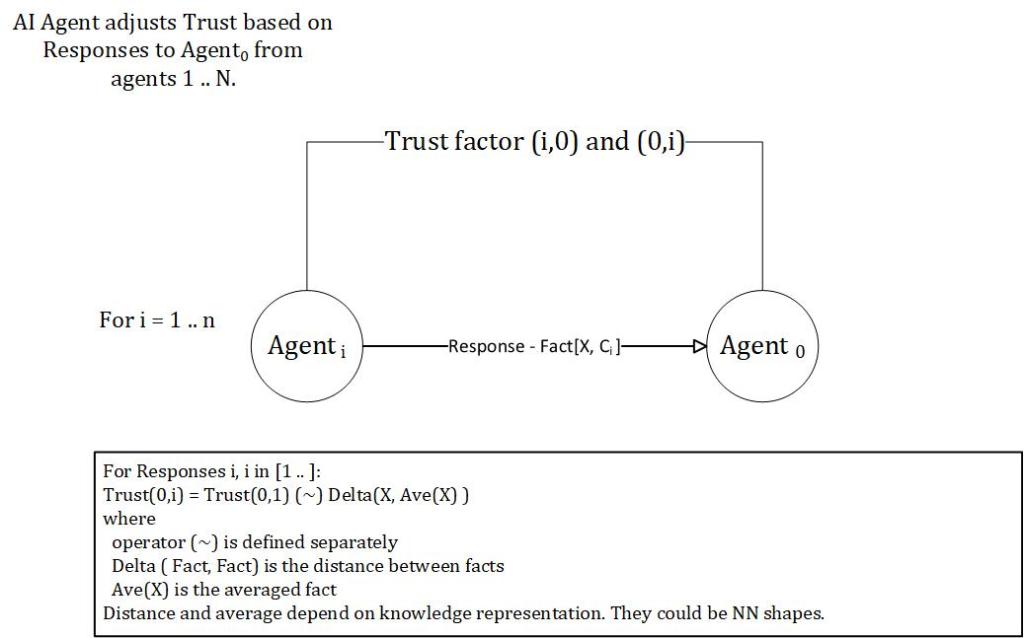
This reflects trust relationships between two agents (components), i and 0 (self). The relationship is asymmetrical on every attribute, attributes between agents may differ, and the trust levels are a function of past experience.
With such mechanism it is possible to build systems that gradually learn appropriate trust levels with their environment, The correct trust level is essential for continuous operation. It is argued that without that capability it is not possible to build an artificial intelligence system that can operate in an open environment – i.e. so-called AGI can not work without a proper trust adjustment technology in place.
 Modular AI systems